Jammu Kashmir is a Union Territory in northern India. On 5th August 2019; the central government has removed the special status of the Jammu and Kashmir after abolishing article 370 of the Indian Constitution.
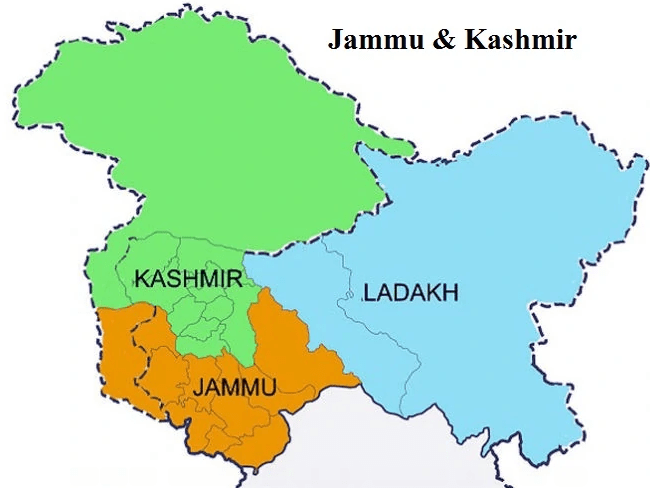

Facts about Jammu & Kashmir:
| 1. Area | 2,22236 sq km. |
| 2. Population | 1.24 cr (2011 census) |
| 3.Establishment | 26 Oct, 1947 |
| 4. Principal & Official Languages | The official language of the state is Urdu. Other languages are Kashmiri, Dogri, Pahari, Balti, Ladakhi, Punjabi, Gurji, Dadri |
| 5. Neighboring States | Himachal Pradesh, Punjab |
| 6. Capital | Srinagar (Summer), Jammu (Winter) |
| 7. Members of Parliament | Lok Sabha- 6, Rajya Sabha- 4 |
| 8. Legislature | Unicameral, 107 (24 from POK vacant) +2 (Nominated) |
| 9. Airports | Jammu, Srinagar |
| 10. Major Cities | Srinagar, Jammu, Anantnag,, Udhampur, Baramula, Sopore, Bandipura and Leh |
| 11. Festivals | Assuj, Lohri, Sinh Sankranti,Bahu Mela In Jammu, Id-Ul-Fitr, Id-Ul-Juha, Milad-Ul-Nabi, Muharram, Hemis in Laddakh |
| 12. Economy Size | US$ 16.74 billion,J&K is best known for Horticulture products, Temperate Fruits, Apple, Peach Plum, Cherry, Almond Etc.Its 80% population is dependent on Agriculture and 45% economic revenue is from Agro-Horticulture sales |
| 13. Literacy | 83.45% |
| 14. Districts | 22 |
| 15.Sex Ratio (as per 2011 census) | 880/Thousand male |
| 16. Principal Dances | Rouf (women-romance and heroic), Kudra ( Dogra men), Hemis Gumpa, Chakri |
| 17. Principal Rivers | Indus, Jhelum, Chinab, Ravi and Sindh |
| 18. Principal Minerals | Coal, Copper, Zinc, Lead, Limestone, Bauxite And Lignite, Mica |
| 19.Passes | Zoji la, Pir Panjal, Great Himalaya, Zaskar, Laddakh (little Tibet), |
| 20. Tourist & Historical Places | Apharwat Peak (Gulmarg), Shankaracharya Hill (Srinagar), Dal Lake (Srinagar), Gulmarg Gondola (Gulmarg), Indira Gandhi Tulip Garden (Srinagar), Nigeen Lake (Srinagar), Mughal Gardens (Srinagar), Amarnath Cave (Anantnag), Zojila Pass (Sonamarg),Gulmarg Alpine Guides (Gulmarg). |
| 21.Lakes | Wular, Achal, Dal, Pangong, Moriri, And Kar |
| 22. State density | 653 person/ km2 |
| 23. Child Sex Ratio | 795/ 1000 male Child |
What the two articles mean:
Article 370
History
In October 1947, the then-Maharaja Hari Singh of Kashmir signed the ‘Instrument of Accession’, which specified three subjects on which Jammu and Kashmir would transfer its powers to the government of India: 1. Foreign affairs, 2. Defence and 3. Communications. In March 1948, the Maharaja appointed an interim government in the state, with Sheikh Abdullah as the prime minister. In July 1949, Sheikh Abdullah and three other colleagues joined the Indian Constituent Assembly and negotiated the special status of J&K, leading to the adoption of Article 370. The controversial provision was drafted by Sheikh Abdullah.
What are the provisions of Article 370?
Parliament needs the Jammu & Kashmir government’s nod for applying laws in the state — except defence, foreign affairs, finance, and communications.
The law of citizenship, ownership of property, and fundamental rights of the residents of Jammu & Kashmir is different from the residents living in rest of India. Under Article 370, citizens from other states cannot buy property in Jammu & Kashmir. Under Article 370, the Centre has no power to declare financial emergency.
It is important to note Article 370(1)(c) explicitly mentions that Article 1 of the Indian Constitution applies to Kashmir through Article 370. Article 1 lists the states of the Union. This means that it is Article 370 that binds the state of J&K to the Indian Union. Removing Article 370, which can be done by a Presidential Order, would therefore make the state independent of India.
Temporary provision or not?
A petition filed by Kumari Vijayalakshmi Jha challenged the validity of Article 370 against the Delhi High Court’s April 11, 2017 order. The petition had said that the continuance of the temporary provision of Article 370 even after dissolution of Constituent Assembly of J&K, and that of J&K Constitution, which has never got the assent of the President of India or Parliament or the government of India, “amounts to fraud on the basic structure of our Constitution”.
Article 35A
What is it?
Article 35A gives the Jammu & Kashmir Legislature full discretionary power to decide who the ‘permanent residents’ of the state are. It gives them special rights and privileges regarding employment with the state government, acquisition of property in the state, settling in the state, and the right to scholarships and other forms of aid that the state government provides. It also allows the state legislature to impose any restrictions upon persons other than the permanent residents regarding the above.
To guarantee these special rights and privileges, the Article says no act of the state legislature that comes under it can be challenged for violating the Constitution or any other laws.
So the provisions of the article 370 came into force from 17 November, 1952. Now let’s understand the key provisions of the article 370 of the Indian constitution.
Article 370 gives the following rights and facilities to the citizens of J & K;
1. Jammu & Kashmir; is an integral part of the Indian Union. But its area, name and boundary can’t be altered without the consent of the state assembly.
2. According to this article, the central government has to get approval from the state government to implement all other laws except defense, foreign affairs and communication in the state.
3. Jammu and Kashmir has its constitution because of article 370 and its administration is run accordingly not according to the Constitution of India.
4. J & K has 2 flags; One of Kashmir and another is India’s Tricolor flag.
5. The citizens of other Indian states can not buy any property or kind of any property in this state. It means, the fundamental right to property is still in force in this state.
6. The people of Jammu and Kashmir have two types of citizenship. One is Indian citizenship and another is Kashmiri citizenship. Worth to mention that no other Indian can have two citizenship simultaneously.
7. If a Kashmiri woman marries an Indian, then her Kashmiri citizenship terminates, but if she marries a Pakistani, it does not affect her citizenship status.
8. If a Pakistani boy marries a Kashmiri girl, he gets Indian citizenship too while Indians don’t have this privilege.
10. Part 4 of the Indian Constitution (Directive Principal of State Policy) and Part 4A (Fundamental Duties) are not applicable in this State.
It means the citizens of Kashmir are not bound to save the cow, maintain the dignity of the women and respect the National Flag of India.
11. One of the most shocking right is that Insulting National Symbols of India (National Anthem, National Flag etc.) in J & K does not fall under the category of crime.
12. The President of India does not have power to declare financial emergency in the state.
13. Any amendment in the Constitution of India does not apply automatically to J & K unless a special order of President is not passed.
14. The Central government can impose National Emergency in the state in two conditions only; war and external invasion.
15. The President has no power to suspend the constitution of the state on the ground of failure to comply with the directions given by him.
16. If the national emergency is imposed in the country on the basis of internal disturbance; this emergency is not applicable in the Jammu and Kashmir until it is approved by the state government.
17. The Central Government can not impose National Emergency in the state on the basis of internal disturbance in the state. The central government must take the permission of state government before doing so.
18. Only the resident of the Kashmir can take selection in the jobs of the state government.
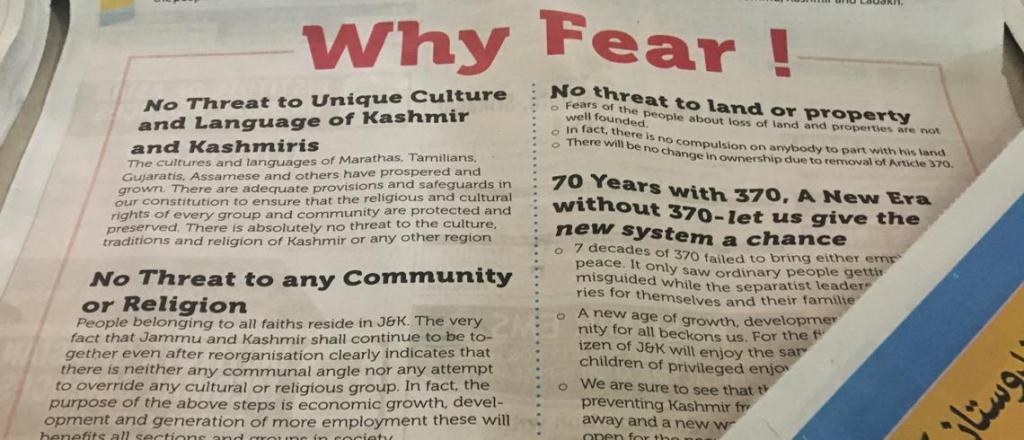
It is clear from the facts given above that Jammu and Kashmir is a integral part of the Indian but this state have some special provisions for its citizens which are not enjoyed by the other Indians.
“A leader is not born out of the blue. You have to know the pulse of the people from Kashmir to Kanyakumari and from Gujarat to Guwahati. You have to relate yourself with them, and only then does one become a leader”
Hence ,It was important to do this and indian government did the right thing.
 Words and wonders!
Ur fanboy here, I love your work!!
LikeLiked by 1 person
Thank you so much! ❤
LikeLike
Nice one
LikeLiked by 1 person
Thank you❤
LikeLike